
By Stephen Jones, with Ruth Carol Cushman and Peter Ruprecht
November 2026
We expect birds to begin nesting in spring, but our Golden and Bald Eagles get an early start, rebuilding nests and advertising their nesting territories during fall and early winter.
Most of Boulder County’s more than a dozen Golden Eagle nesting pairs place their nests on cliff ledges in the foothills and mountains; most of our 15 or so Bald Eagle nesting pairs place their giant stick nests in cottonwoods on the plains.
Both species usually mate for life – the pair stays together until one dies, and then they will re-pair. Bald Eagles maintain and defend their nests during 12 months of the year; Golden Eagles may move out on the plains to forage during the colder months but are usually back refurbishing their nests by January.
Local naturalists have tracked nesting Golden Eagles in Boulder County since the 1880s, when a retired mining engineer named Denis Gale hiked throughout our mountains and foothills seeking out nesting birds. He found a half-dozen Golden Eagle nesting sites. Using Gale’s notebooks, which are stored in the University of Colorado Norlin Library rare books room, along with checklists compiled by early twentieth century naturalists, Boulder County Nature Association founding members Mike Figgs and Nancy Lederer located five of these six sites, along with a dozen more.
The most prominent of Gale’s sites lies in Lefthand Canyon. The largest of several eagle nests at the site perches on a ledge halfway up the cliffs and is roughly 8 feet across and 4 feet high. Over the past four decades, we’ve watched the Lefthand Canyon nesting pair rotate from this nest to nearby smaller nests from year to year.
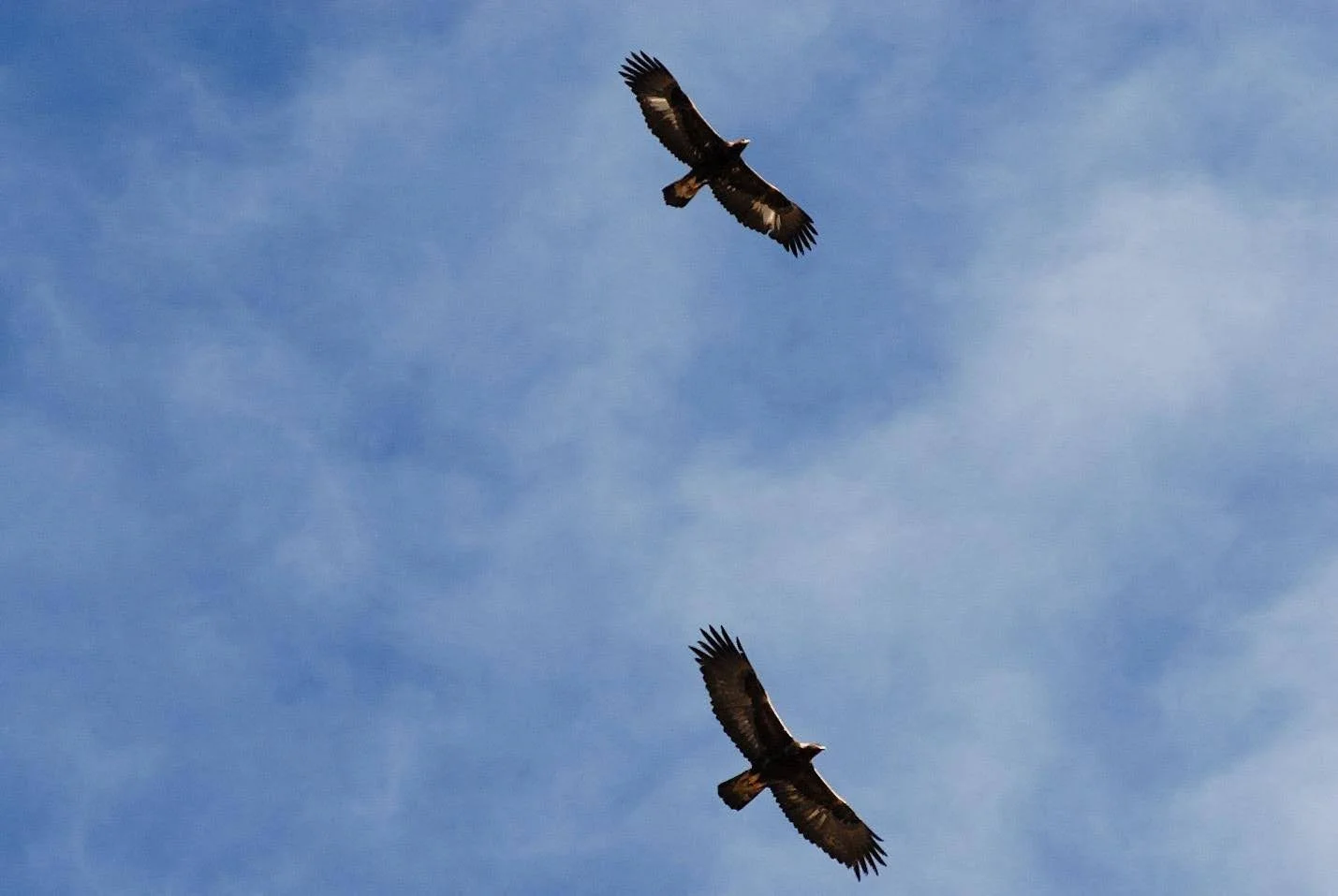
We often see adult golden eagles (lower) soaring with their young (upper) over the foothills in winter. Note the prominent white patches on the wings of the immature bird. Photo by Stephen Jones.
We first met “Mabel,” a mature female whose bleached neck and back feathers suggested advanced age, in winter of 1981 as she perched on the largest Lefthand Canyon nest. We watched her mate cruise along the cliff face before flaring his wings and landing on the edge of the nest with a stick in his beak. Mabel took the stick and tucked it into the side of the nest. Later, we saw the pair circling above the cliffs, locking talons, and tumbling, eagle over eagle, until they parted just a few feet above the cliff rim.
We watched Mabel audition her mate by carrying sticks or rocks high into the sky, dropping them, and seeing if he could snare them before they hit the ground. We watched the male escort other raptors through the nesting territory, which appeared to extend for a mile or more in all directions from the nest. We saw the pair fly together to remote corners of their territory where they advertised their domain by copulating on prominent rocks.
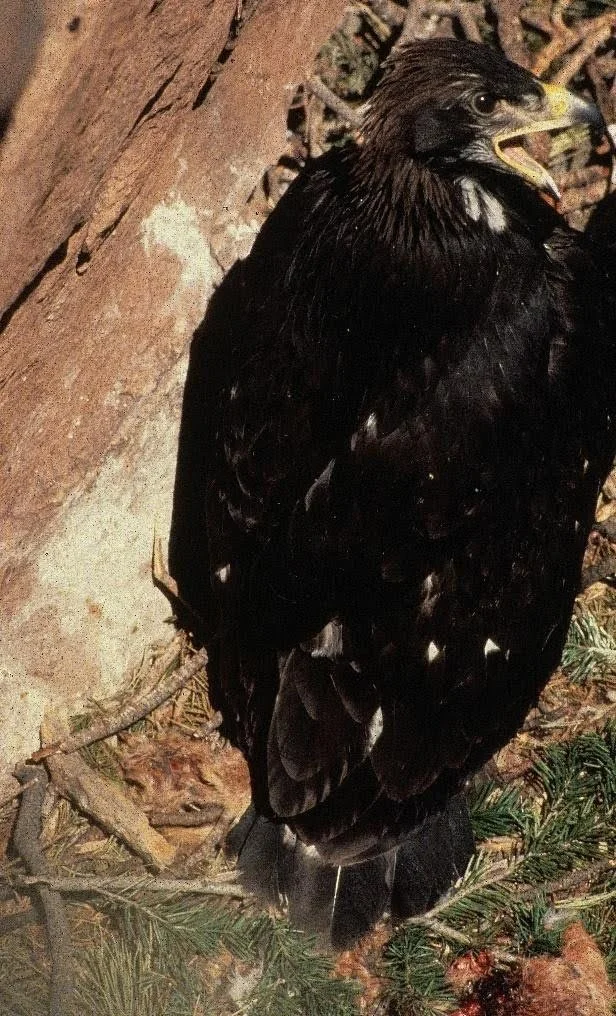
A young golden eagle cries out to its parents from a cliff nest in early July. Note the prairie dog carcass and the Douglas-fir bough on the nest.
We could tell when the eggs had hatched because the male would bring Mabel a present, often a pine bough to shield the chicks from the sun or protect them from falling over the edge of the nest. Throughout incubation and rearing of the young, we would see the male bring prairie dogs, cottontails, and parts of jackrabbits to the nest.
Remarkably, we were able to watch Mabel and her interactions with two different male partners for nearly a decade. During that time, she reared at least 8 baby eagles. One spring, a young female replaced her, and we all felt a sense of loss.
Golden eagles nest throughout the world, including Asia, North Africa, and Europe. North American nesting populations extend from Alaska south along the Pacific Coast to Northern Mexico, and eastward across the Rocky Mountains to the Dakotas, western Nebraska, and west Texas. Scattered nesting pairs breed in northern Canada from Alaska east to Newfoundland.
While Golden Eagle nest productivity within Boulder County has remained nearly constant since 1990, our Boulder County Nature Association wintering raptor study has tracked a nearly 50% decline in numbers of Golden Eagles wintering on the plains of Boulder County.
This decline may result in part from the extirpation from our local grasslands of one of the eagles’ primary food sources, the white-tailed jackrabbit. Our last documented observation of jackrabbits on the plains of Boulder County occurred in 2012.
With no jackrabbits and fewer prairie dogs available locally, our nesting goldens may roam farther out on the plains to forage. This extra expenditure of energy and time could eventually compromise their nesting success.
Meanwhile, Golden Eagle pairs have abandoned nesting territories west of the Denver metro area, where housing developments and hiking trails have encroached on nesting cliffs.
Installation of wind power turbines throughout eastern Colorado has contributed to reduced numbers of nesting Golden Eagles. USGS scientists concluded in a 2022 study that if enough new turbines were installed to enable the United States to meet its 2040 wind energy goals, we’d lose up to half of our nesting golden eagle population.
During 2022, one Wyoming energy company was fined for exceeding their annual “quota” when 150 golden eagles were killed by their wind turbines.
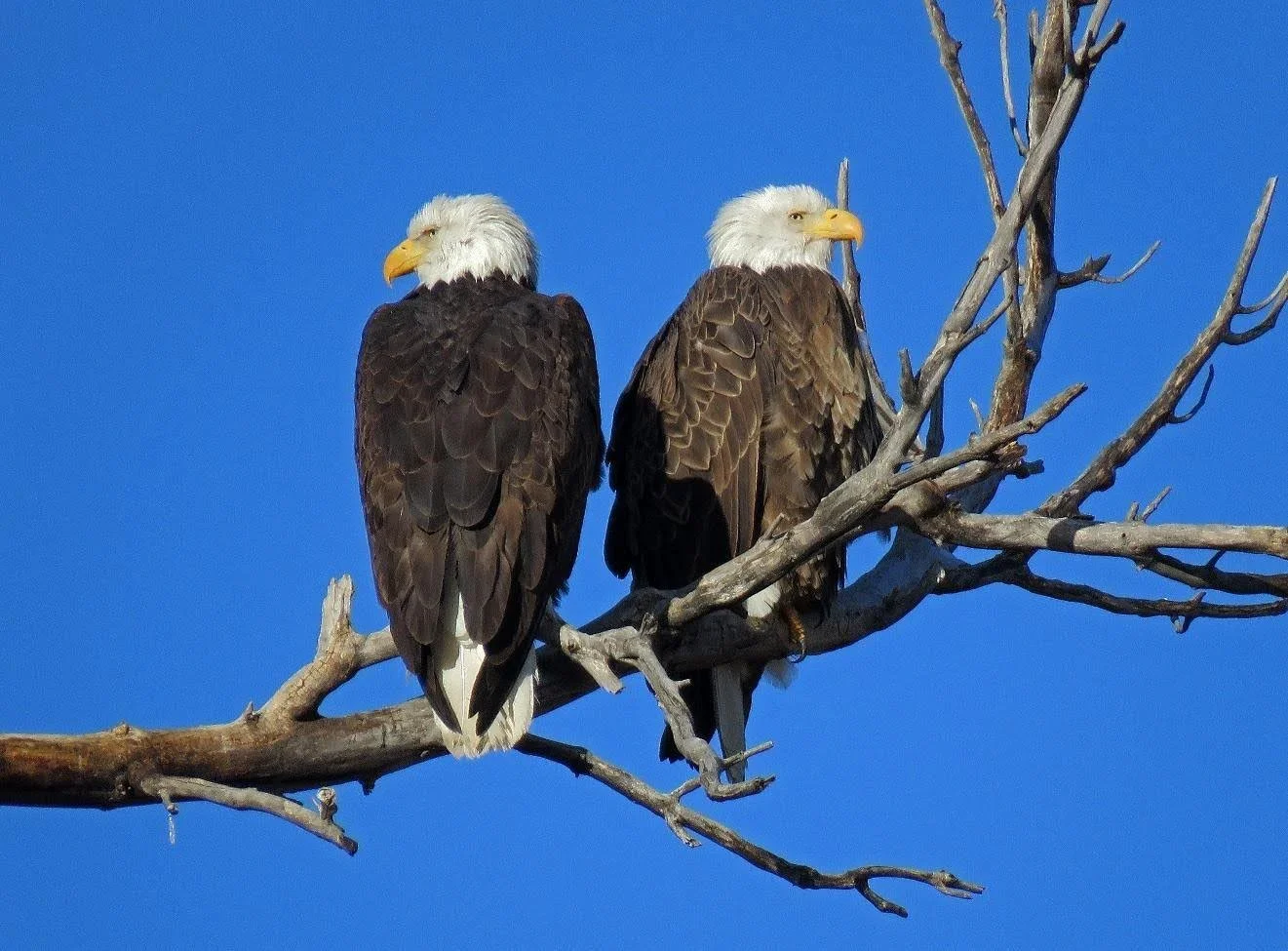
We found this pair of Bald Eagles perched a few yards from their nest in a cottonwood along Boulder Creek in December. Note the female’s (right) larger size. Photo by Stephen Jones.
Meanwhile, Bald Eagles, which were first reported nesting in Boulder County during the 1990s, continue to increase in number. Their autumn and winter courtship includes the “death spirals” performed by the goldens, along with rollercoaster-ing flights, perching close together on bare limbs, and copulating on their nests.
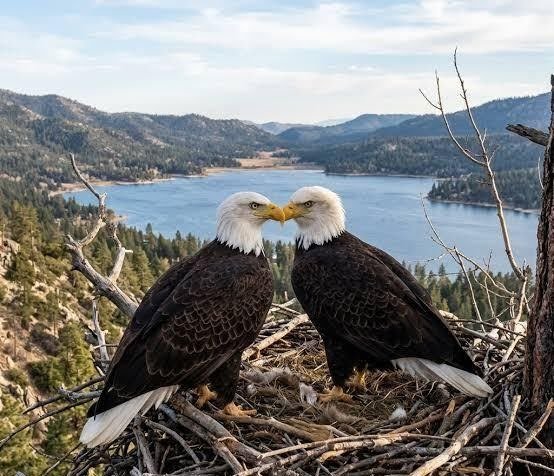
Jackie and Shadow court on their giant nest overlooking Big Bear Lake. Jackie died in August 2026 after a territorial fight with other eagles left her helpless on the ground. An autopsy determined that she had been weakened by avian flu and the presence of rat poison in her blood. She was approximately 14 years old. You can watch a live cam of the nest on YouTube provided by Friends of Big Bear Valley.
If you’d like to get to know Bald Eagles personally, we highly recommend the Friends of Big Bear Valley Bald Eagle nest cam in Southern California. Every year hundreds of thousands of Bald Eagle lovers watch the pair refurbish their nest high in a conifer overlooking the lake, incubate eggs, feed their young, and help their fledglings learn how to fly.
Last spring we held our breath and then cringed as a pair of common ravens raided the nest, making off with the two young chicks. However, the dedicated adults laid another clutch, and by July we were rewarded with close-up views of the full-grown young posing on the nest with their parents. It was just a few weeks later that Jackie died.
A public memorial of her life was held near the nest site on October 3. More than one thousand eagle-lovers attended the service in person and tens of thousands attended online. Shortly after Jackie’s death, a new female, KD1 (“Katie”), arrived on the territory. Shadow and Katie have bonded, and nest monitors expect to see them mating and upgrading the nest by December.
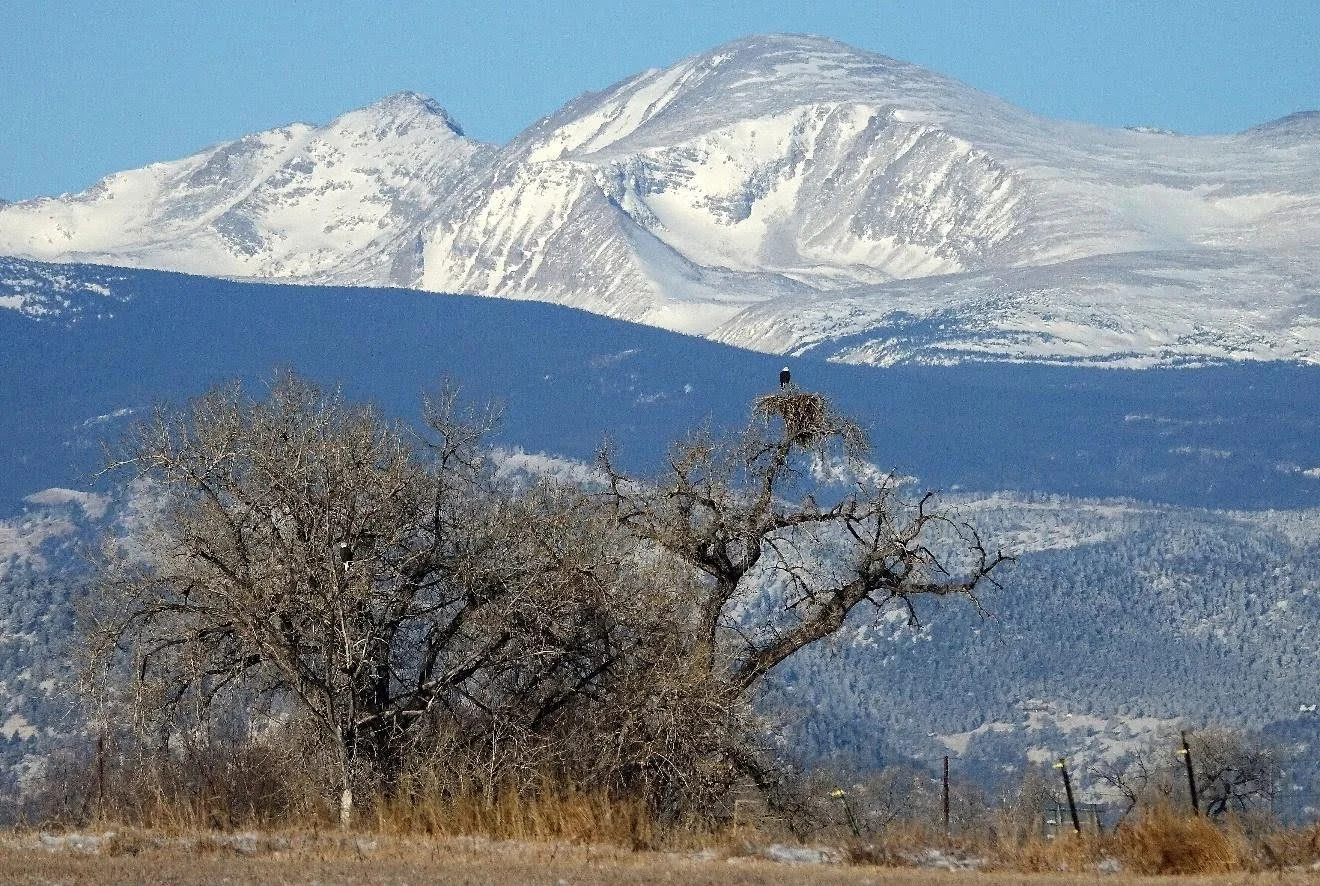
A pair of Bald Eagles established their nest (top right of tree) in a cottonwood near Stearns Lake more than 20 years ago, and the territory remains active today. Photo by Stephen Jones.
Other November Events
Wild turkeys court and strut at local open space properties, golf courses, and shopping centers.
Elk descend to the foothills and plains to overwinter. Two of our largest herds can be seen at Table Mountain north of Boulder and along Coal Creek south of Boulder.
Great Horned Owls hoot at dusk and dawn as they establish nesting territories. The male’s hooting sequence often consists of four individual notes; the female’s is higher-pitched and may include up to seven notes.
Early Easter Daisies begin to bloom on foothills shales in Boulder Mountain Park.
On warm, sunny mornings, Buckeye and Painted Lady butterflies continue to bask on late-blooming rabbitbrush flowers on the plains.
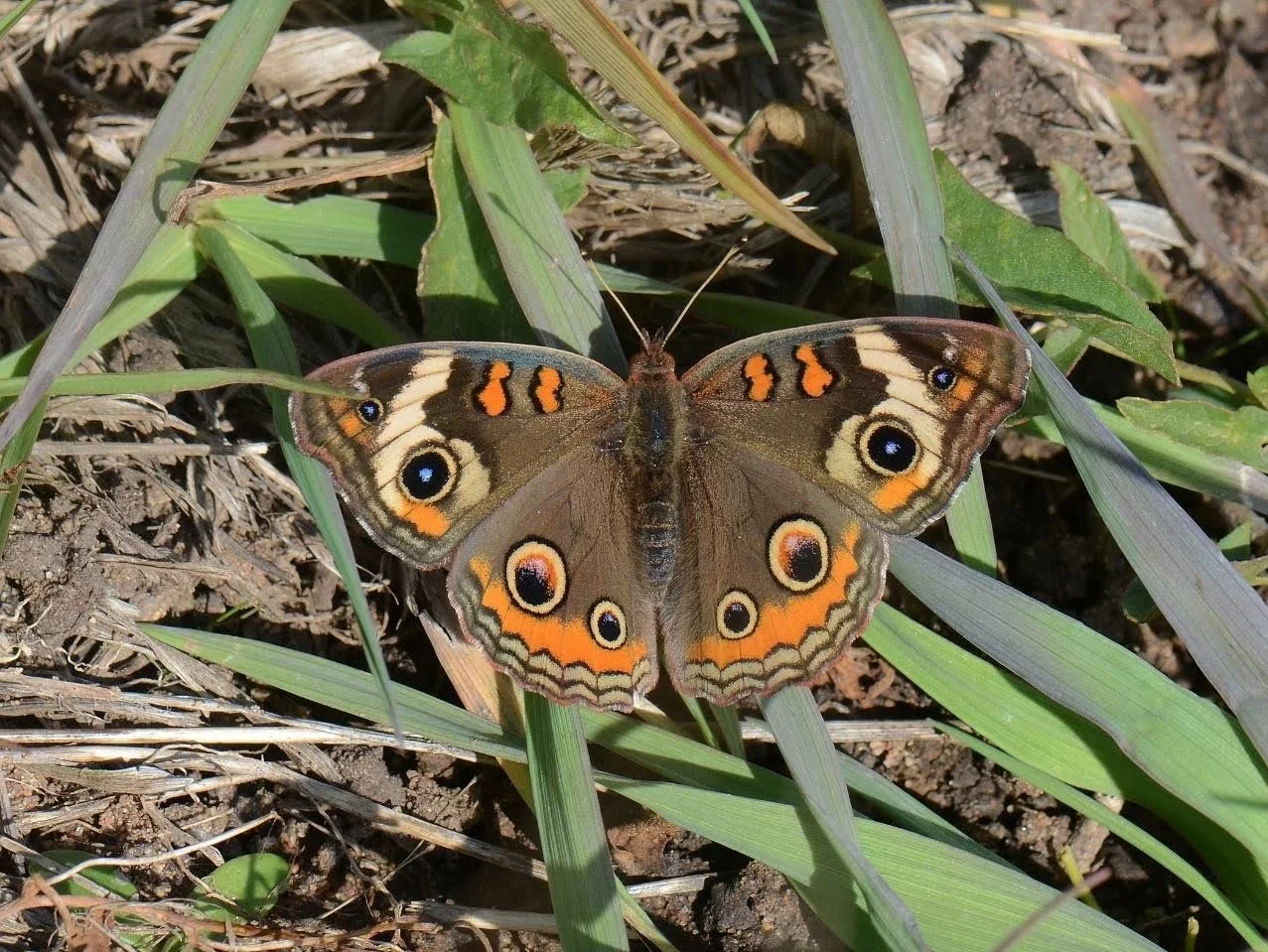
This Buckeye was basking in the morning sun on Shanahan Ridge in late October. Photo by Stephen Jones.