January Nature Almanac: Warm Early Winter Offers Unique Views of Diving Ducks
By Stephen Jones with Ruth Carol Cushman
January 2026
After day upon day of unseasonably warm temperatures, it’s hard to believe that this past September-December was not the warmest fall and early winter period on record in Boulder County. That distinction belongs to 1933, when, during the height of the Dust Bowl, the city of Boulder experienced a fall and early December that was 6° F warmer than average. During that year, both Boulder and Denver set December high temperature records of 79° F.
This year’s December 22 high of 76° F in Boulder and Denver came close to that record, and temperatures remained warm enough this fall to keep local ponds and lakes ice-free throughout December and into January. As a result, long after diving ducks and other migratory waterfowl have usually flown south to overwinter, we have the chance to see them courting close-up.
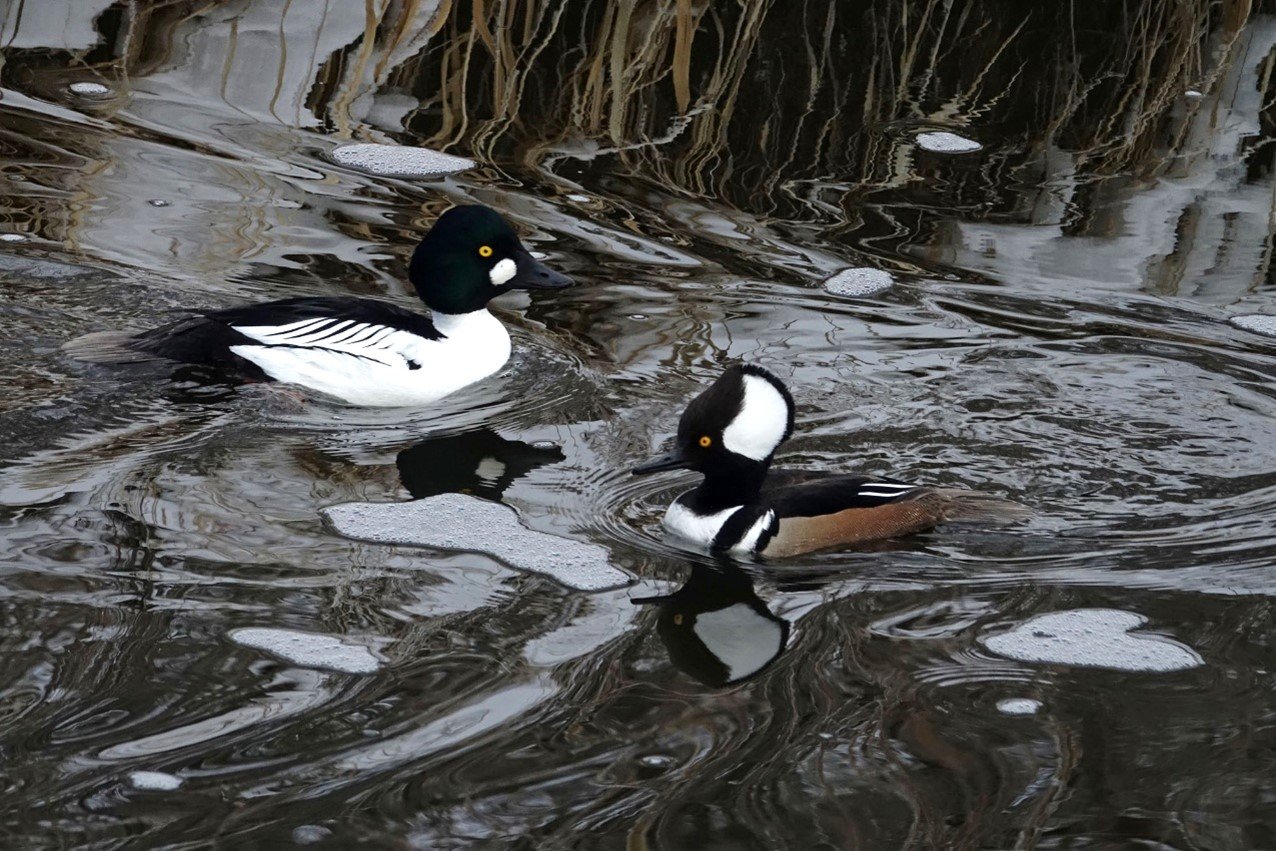
Common Goldeneye male, left, and Hooded Merganser male, right. Photo by Stephen Jones.
In early December, we watched three Hooded Merganser males fanning out their white hoods for two seemingly disinterested females on Coot Lake, just north of Boulder Reservoir. At Golden Ponds in late December, a dozen Common Goldeneye males were beginning to throw their heads back and skim across the surface while following a half-dozen females.
As January progresses, these breeding displays will grow more desperate as up to a half-dozen males of each species circle around a receptive female, throwing back their heads and dancing across the water while issuing a series of cackling calls. Actual breeding should begin by February, and by March most of these cavity-nesters should begin flying north to seek out woodpecker holes in conifers of the northern Rockies, western Canada, and Alaska.
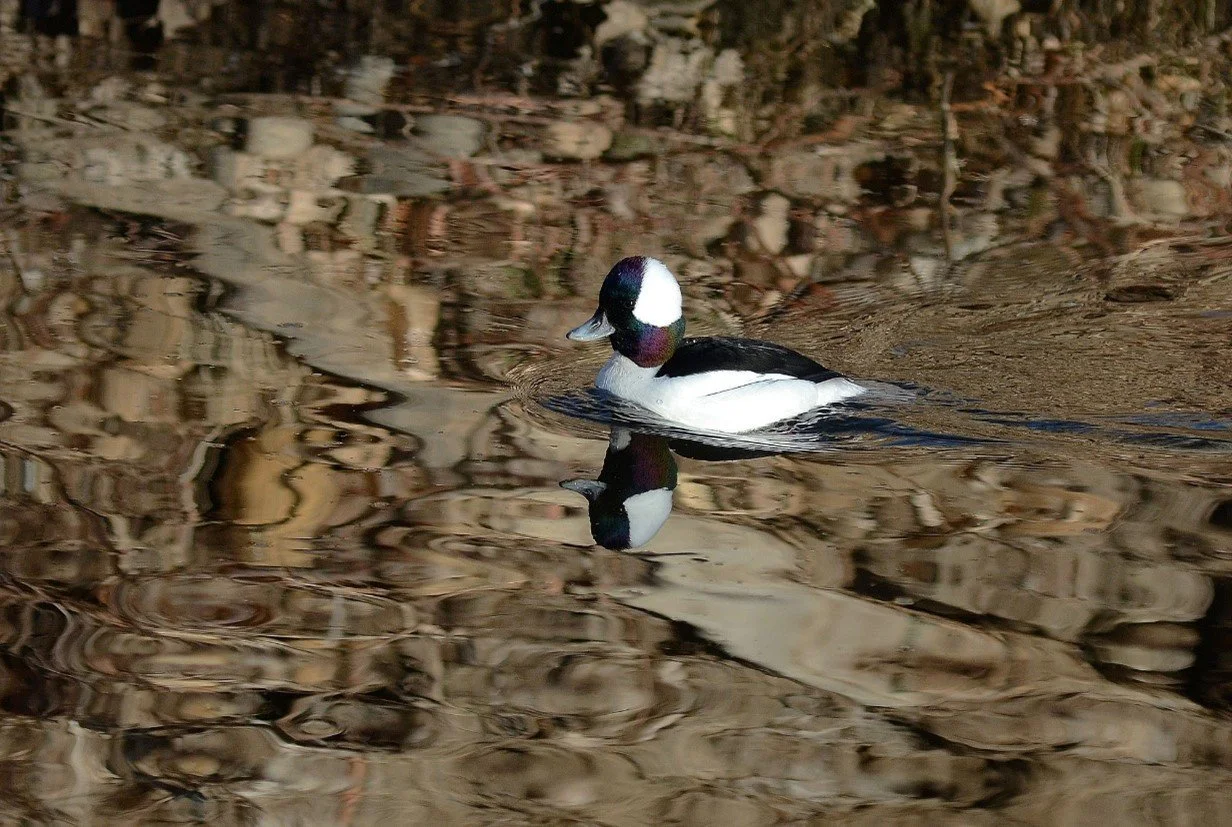
Bufflehead Males also display on ice-free ponds in winter. Photo by Stephen Jones.
During the past couple of decades, a few pairs of Hooded Mergansers have begun nesting in cottonwoods surrounding shallow ponds east of Golden and around Union Reservoir east of Longmont. Common Mergansers, also cavity-nesters, now nest around ponds east of Lyons and near Union Reservoir, east of Longmont.
One of our favorite places to observe diving ducks is Golden Ponds, on the west side of Longmont, where in late December we saw Common Goldeneyes diving for small fish and mollusks. Meanwhile, two dozen Ring-billed Gulls circled close overhead, with individuals plopping down into the circular rings made by the diving ducks and waiting ravenously until the diving individual popped up to the surface. Spirited chases followed, while a half-dozen Great Blue Herons, usually uncommon in winter, perched in a leafless cottonwood, watching with interest.
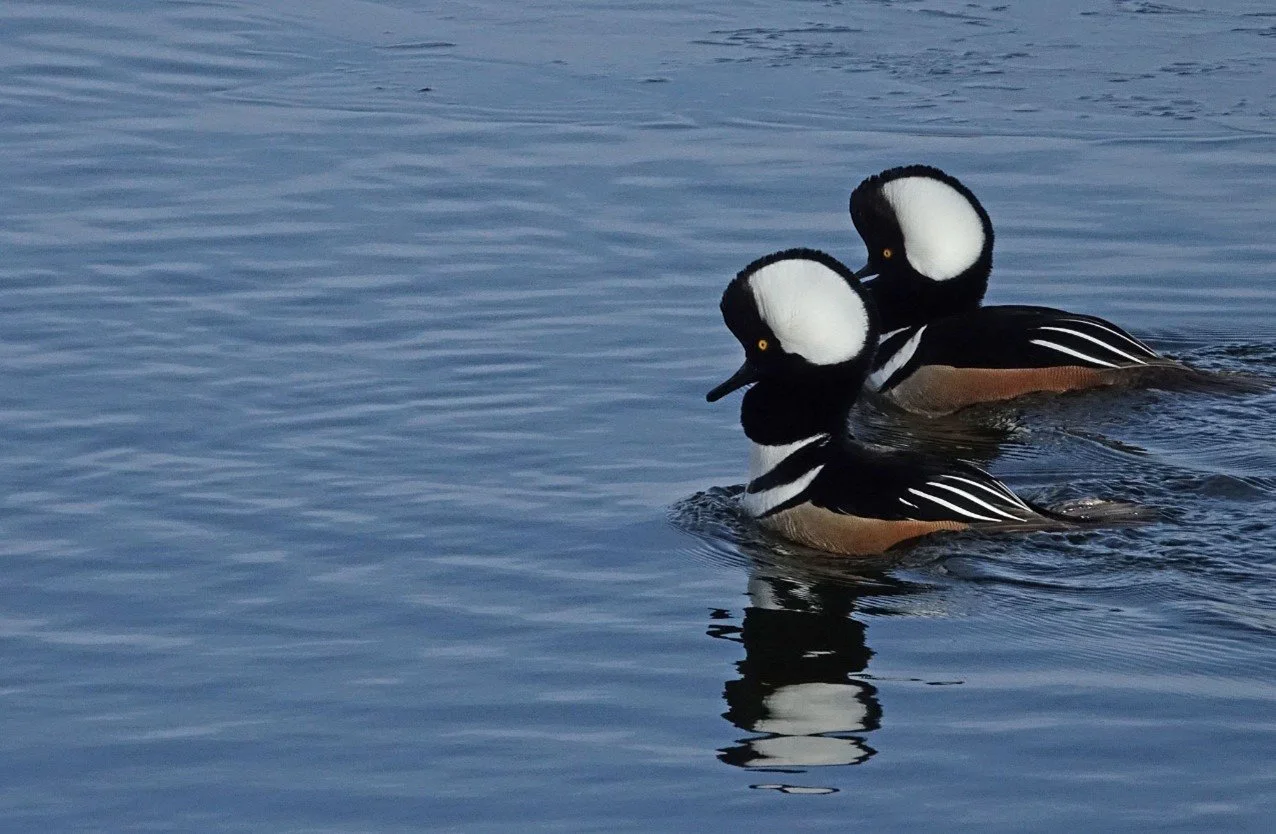
Displaying male Hooded Mergansers. Photo by Stephen Jones.
A similar weather pattern last year left many of our ponds ice-free throughout December, but sub-zero temperatures in January and February forced the waterfowl southward. Will this be the first year we’ve experienced when local ponds remain ice-free throughout the winter?
Other January Events
A bumper cone crop is attracting flocks of Red Crossbills, nuthatches, and woodpeckers to our foothills ponderosa pine forests. Check out Meyers Gulch at Walker Ranch County Open Space or the Goshawk Trail on Eldorado Mountain.
Great Horned Owls court and lay eggs in tree hollows, on ledges, or on nests previously constructed by hawks or crows.
Beavers begin breeding, and hibernating black bear females give birth to cubs.
Some buds, including Rocky Mountain maple, begin to swell.
Early Easter daisies continue to bloom along shale cliffs bordering Highway 36 north of Boulder.
Nature Almanac is a monthly series by Stephen R. Jones and R. Carol Cushman, along with other guest contributors. Ruth Carol Cushman and Stephen Jones are authors of A Field Guide to The North American Prairie (Peterson Field Guides) and Wild Boulder County: A Seasonal Guide to the Natural World. Ruth Carol and Steve also do a monthly Nature Almanac radio program on KGNU (88.5 FM, 1390 AM) on the first Friday of every month. The programs are archived on the BCNA website for later listening.