December Nature Almanac: A Least Bittern Pays a Rare Late Fall Visit to Sawhill Ponds
By Ruth Carol Cushman and Stephen R. Jones
December 2025
It was tiny, cute, and furtive. And it should have been along the Gulf Coast or in Central or South America. Instead, this Least Bittern was skulking in and out of the cattails at Sawhill Ponds.
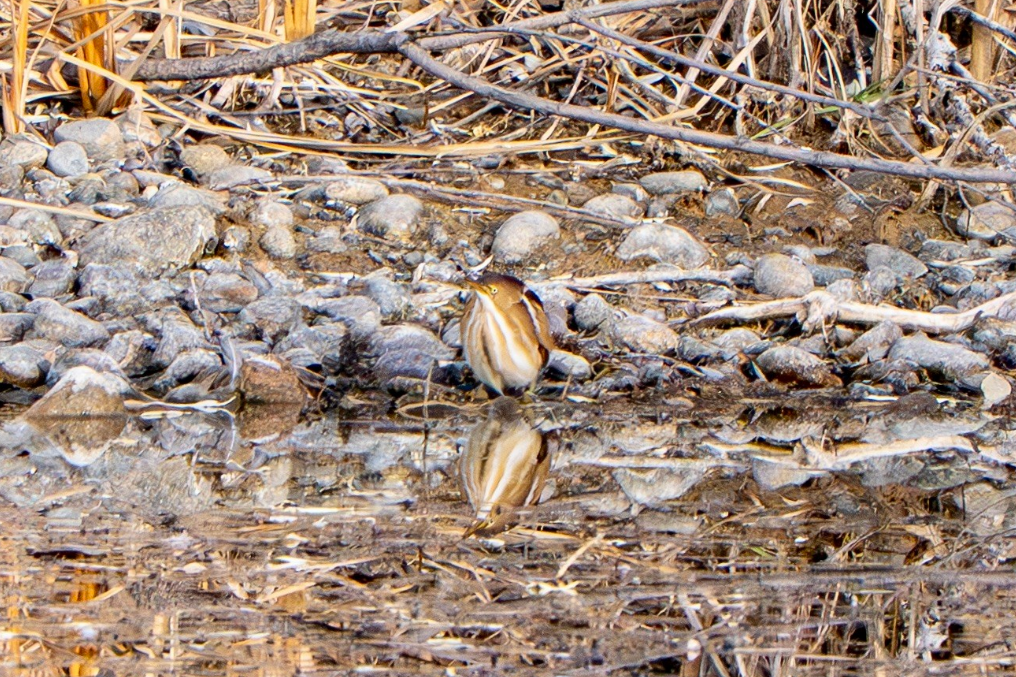
Least Bittern observed at Sawhill Ponds on 15 November 2025. Photo by Winston Liu.
First spotted on November 8, this far-from winter home heron was seen by hundreds of people at the small pond northeast of the Sawhill Ponds parking lot. Thanks to Joannie, a friendly birder with a scope, we finally got to see the bird on November 16, after four previous attempts. It has not been reported on eBird since the 17th and we hope it has found its way south.
Sawhill Ponds is one of the few places in Colorado where Least Bitterns have nested. In Birds of Colorado, Bailey and Niedrach write that the first eggs collected in the state came from Greeley on June 1, 1903. They also say a nest with four eggs was found in a Boulder marsh on June 5, 1910. Could it have been Sawhill Ponds? According to the second edition of Colorado Breeding Bird Atlas, this elusive bird remains an “extremely rare breeder in the state.” It is even rarer to find it at the end of fall.
Although furtive, the Least Bittern does not seem to be especially afraid of people. Alfred Bailey reports on photographing a nesting female: “With my head in the hood of the camera I walked within three feet of the bird and took a series of pictures before she flushed. Within half an hour the female returned and fed the young by regurgitation.” Nowadays, with zoom lenses, Bailey’s behavior would be unacceptable, but this happened many decades ago.
Measuring between 11 and 14 inches in length, Least Bitterns (Botaurus exilis) are the smallest of the heron family. Cornell’s All About Birds website says it is “often little more than a voice in the reeds that is frustratingly difficult to locate.” If you catch a glimpse of a slightly hunched buffy, brown, and chestnut heron with a dagger-like yellow bill—that’s it! Compared to Cornell’s photos, “our” Least Bittern seemed muted in color, and may have been a female or a youngster.
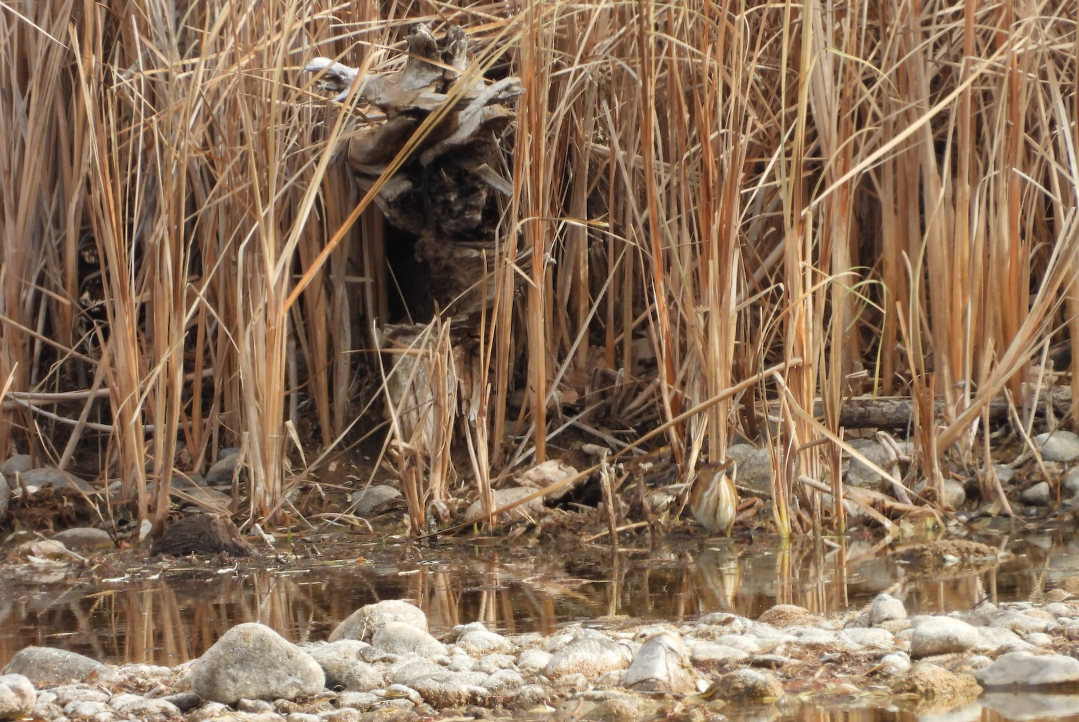
The patterning on the breast of a Least Bittern camouflages well with the fall cattails at Sawhill Ponds on 15 November 2025. Photo by Zak Hepler.
Here are a few of Cornell’s “cool facts”:
Like the American Bittern, the Least Bittern freezes in place with bill pointing up when alarmed. It “sometimes sways to resemble windblown marsh vegetation.”
John James Audubon said that a young captive Least Bittern—measuring 2.25 inches wide--could “walk with ease in a 1.5 inch gap between two books” showing how it can compress itself to squeeze between reeds.
When a male is excited, the skin between the bill and eye can change from yellow to cherry red.
These birds sometimes appear far outside their normal range. One migrant was found in the Azores, in the middle of the Atlantic Ocean.
Although rare in Colorado and on the list of Species of Concern for Boulder County, Least Bitterns are faring well throughout their range in spite of the destruction of wetlands. If the Trump Administration’s proposal to curtail federal protection of 55 million acres of wetlands passes, we fear wetland destruction will accelerate.
Other December Nature Events
A Neotropic Cormorant has been hanging out with a flock of double-crested cormorants at the ponds at 95th and Boulder Creek, and a flock of American white pelicans has been observed at Walden Ponds.
If autumn’s warm weather persists, be on the lookout for blooming flowers and butterflies. We have recently seen sulphur and cabbage white butterflies and clumps of blooming golden asters, sunflowers, and fleabanes. An early stand of Easter daisies often blooms on the shales in Bear Canyon in time for Christmas.
Dippers bob up and down searching for bug bits in city creeks. Red Crossbills, Clark's Nutcrackers, and Red-breasted Nuthatches may invade the foothills if conifer cone crops are bountiful.
Mule deer mating season ends. Bucks start to lose their antlers and join the yearlings in bachelor groups, moving away from the does and fawns.
Nature Almanac is a monthly series by Stephen R. Jones and R. Carol Cushman, along with other guest contributors. Ruth Carol Cushman and Stephen Jones are authors of A Field Guide to The North American Prairie (Peterson Field Guides) and Wild Boulder County: A Seasonal Guide to the Natural World. Ruth Carol and Steve also do a monthly Nature Almanac radio program on KGNU (88.5 FM, 1390 AM) on the first Friday of every month. The programs are archived on the BCNA website for later listening.