April Nature Almanac: False Flowers Fool Pollinators
By Ruth Carol Cushman with Stephen Jones
April 2026
It looks like a flower. To insects, it smells and tastes like a flower. But actually, it’s a rust fungus, Puccinia monoica, that infects several species of grasses and members of the mustard family.
For many years we puzzled over a small, golden “flower,” one of the first to appear in spring. Then in 2008 we stumbled on an article in Science News, and the mystery was solved. The fungus attacks about 960 species of mustard as well as several grasses.
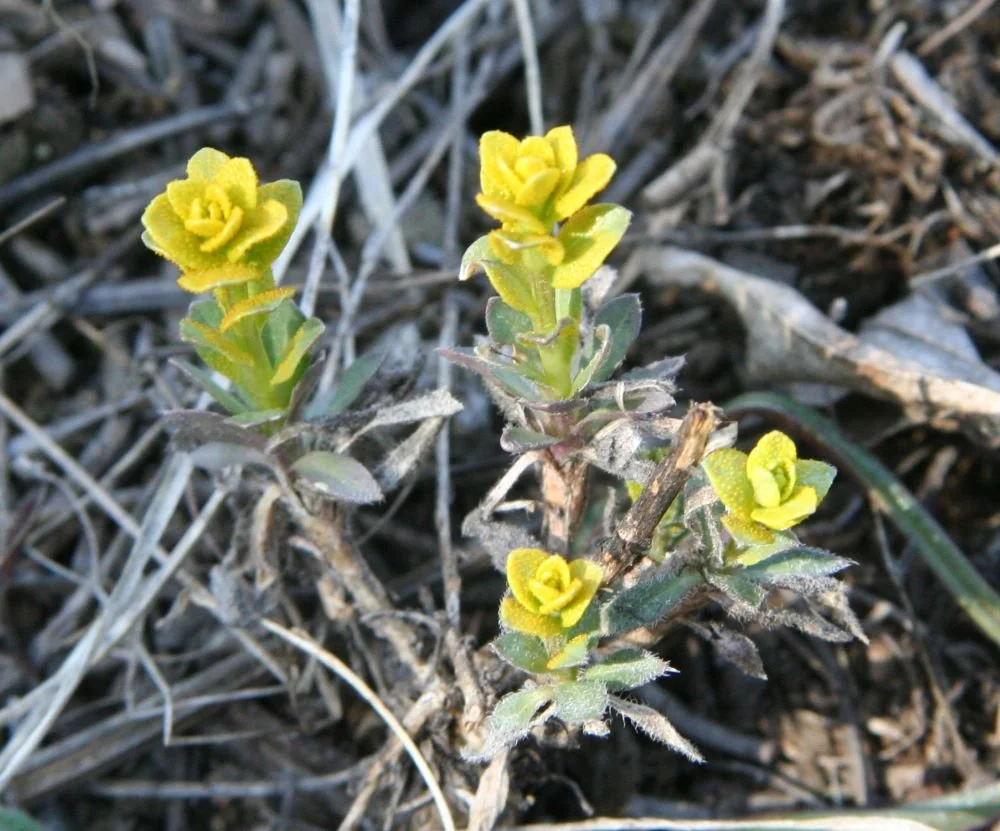
This rockcress has been infected by a rust fungus that makes it look like it has yellow flowers. This rockcress species actually has a pale blue flower. Photo by Glenn Cushman
A little rockcress, Boechera fendleri, that is abundant around Boulder is one of its favorite hosts. Rockcress usually produces pale blue flowers that droop from a slender stem. The fungus, however, inhibits its host from flowering. Instead, the infected cress doubles its leaves, adds swirls to the dusky green rosette at its base and sends up a fake floral shoot that emits an aroma enticing to pollinators. Because the fake flower contains no pollen, the insects fail in their duty to the mustard but do enable the fungi to reproduce sexually, spreading fungal cells from plant to plant. Yellow-orange pustules containing these spores cover the upper leaves of the cress and sparkle when viewed through a hand lens.
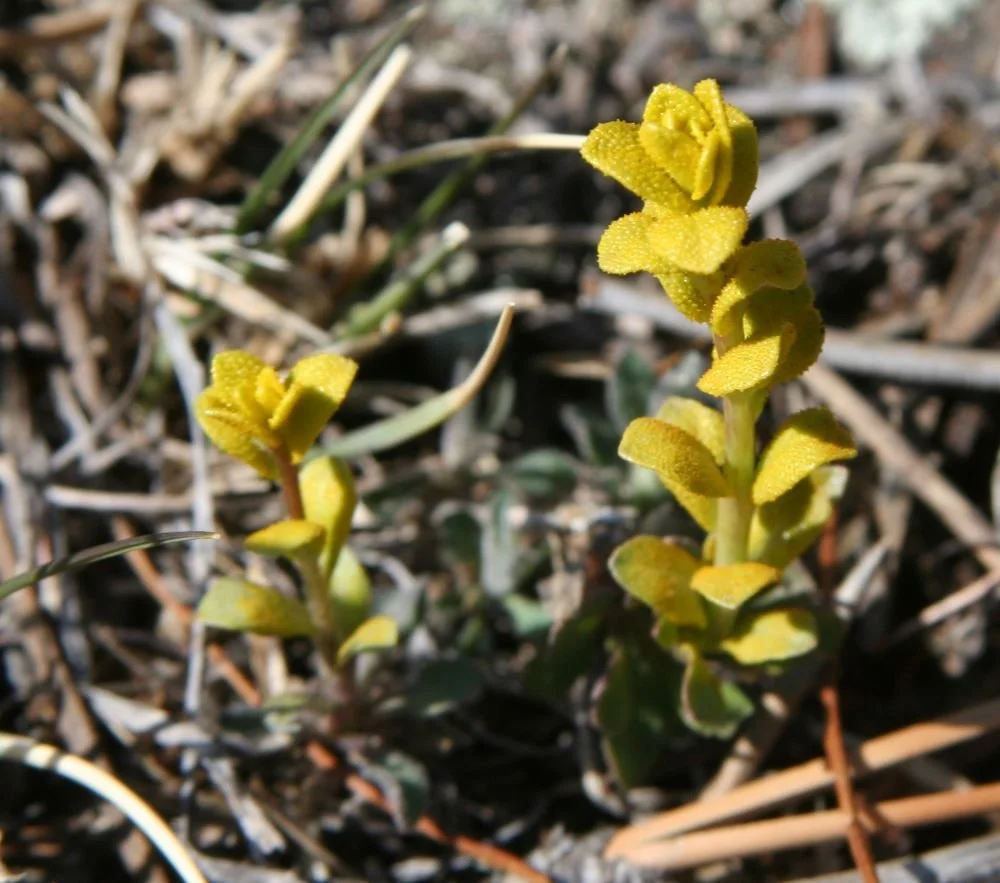
Close details of the rust spores on the false “flowers” of this rockcress. Photo by Glenn Cushman
Barbara Roy, who studied the phenomenon at the Rocky Mountain Biological Laboratory at Gothic, reported that bees, ants, wasps, and flies attracted to the fragrance get 10 to 100 times the sugar from the pseudoflowers as from real ones nearby. Roy wrote that the flower mimics "greatly reduce host reproduction and survival.”
We have found this pretty little impostor in the foothills in March and near timberline in June. It grows only a few inches tall, so look carefully for a small golden spike topped with a "flower” that looks more like a tiny buttercup than a mustard.
More Mustards to Look for in April
Other mustard species flaunt real flowers characterized by four petals and four sepals, often in the shape of a cross, and bloom in early spring.
White candytuft (Iberis amara) pops up in ponderosa forests, and several species of yellow lesquerellas or bladderpods dot dry hillsides.
One of the first hints of spring is the aroma of blue or purple mustard (Chorispora tenella), a weed introduced from Southeast Asia. Its pungent scent can be detected long before you see its flowers.
Alyssum simplex, an invasive European weed without a common name, carpets fields in the foothills and on the plains with yellowish flowers. We marvel that such a minute plant can cast a yellow spell over such vast landscapes.

Bell’s twinpods (Physarria belli) in bloom. Photo by Stephen Jones.
Bright yellow Bell's twinpods (Physaria bellii), by contrast, grow in only one place in the world - on limestone and shale outcrops in Larimer, Boulder and Jefferson counties. These flowers peak in April and May on hogbacks along U.S. 36 north of Boulder.
Other April Events
Pasqueflowers, spring beauties, chiming bells, milkvetches, and wild plums bloom in the foothills attracting early butterflies such as Julia orangetips, cabbage whites, and spring azures.
Burrowing Owls, Turkey Vultures, and Broad-tailed Hummingbirds return from the south.
Bullsnakes awake from hibernation and mate. They eat mice and voles, but also climb trees to take baby birds.
Painted turtles emerge from their winter torpor in the mud and bask on logs at Sawhill and other local ponds.
Beaver, raccoon, and porcupine young are born, and baby prairie dogs appear above ground.
Nature Almanac is a monthly series by Stephen R. Jones and R. Carol Cushman, along with other guest contributors. Ruth Carol Cushman and Stephen Jones are authors of A Field Guide to The North American Prairie (Peterson Field Guides) and Wild Boulder County: A Seasonal Guide to the Natural World.